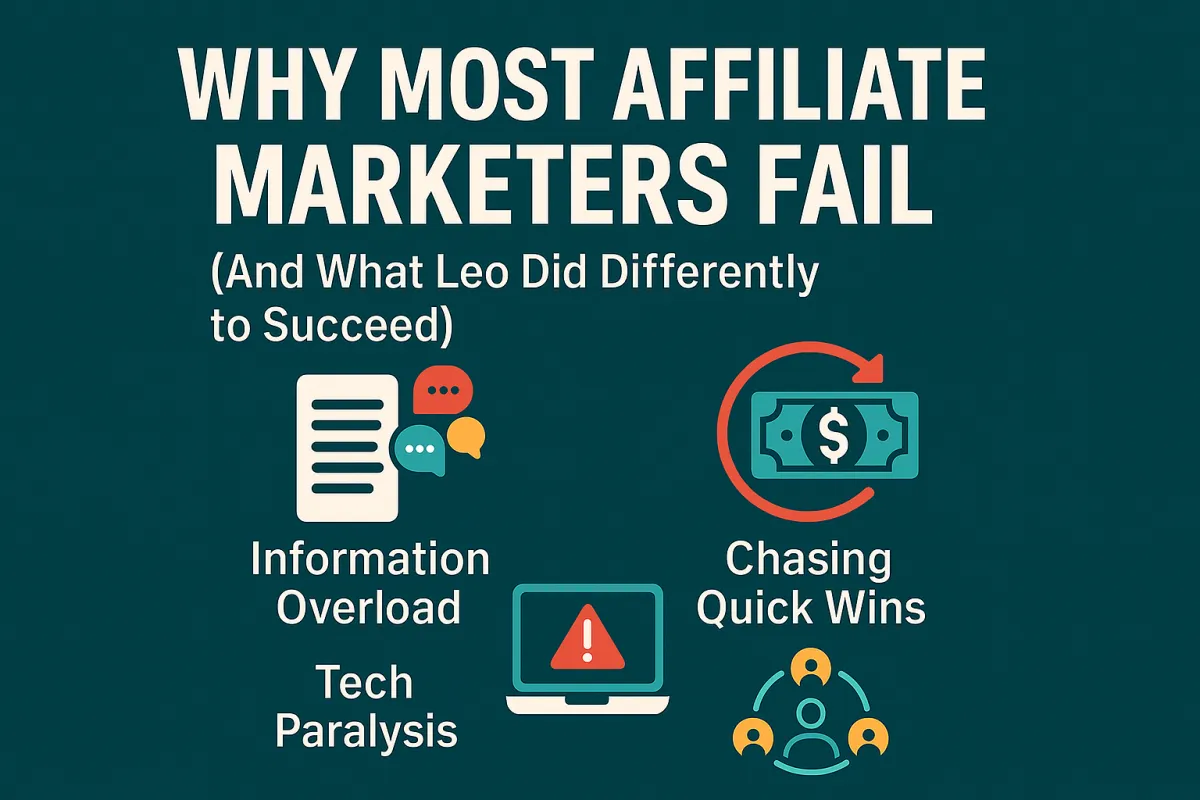
Why Most Affiliate Marketers Fail?
Why Most Affiliate Marketers Fail (And What I Did Differently to Succeed)
Introduction – The Harsh Truth About Affiliate Marketing Failure
Let’s be honest—affiliate marketing is often sold as the “easy button” for making money online. And while it can offer freedom, flexibility, and passive income, the hard truth is this: most people fail.
They jump in, spend money on fancy tools or trendy courses, and walk away months later with little to show for it. But the problem isn’t the model—it’s how it’s being approached.
This blog post is for those who’ve tried and failed, or who are on the fence wondering if affiliate marketing is just another pipe dream. I'm Leo, and I’ve been there. I’m going to break down why most people fail—and exactly what I did differently to start seeing real, consistent success. No hype, no fluff. Just the real deal from someone who’s walked the path.
The Failure Epidemic – Why So Many Quit Before They Win
Affiliate marketing has one of the lowest barriers to entry—but that’s a double-edged sword. Because it’s “easy” to start, people jump in without a plan, strategy, or clear understanding of how to succeed. The result? High dropout rates and a lot of disappointment.
Here’s what typically causes failure:
Information overload – Too many gurus, too many conflicting strategies.
Lack of results – When people don’t earn quickly, they assume it’s a scam.
Trying to do everything at once – Funnels, email lists, content, ads… it’s a lot.
Zero mentorship – Most people don’t know who to trust, so they go it alone.
No support or accountability – Without encouragement, most burn out.
The sad part? Many of these failures could be avoided with a smarter, simpler approach—one that focuses on foundational tools, step-by-step learning, and realistic expectations.
Leo’s Starting Point – Confused, Burned Out, and Broke
When I first dipped my toes into affiliate marketing, I was fresh out of the military. I’d served 23 years, held leadership positions, traveled the world—and yet, none of that prepared me for the chaos of online entrepreneurship.
I wanted freedom. I wanted to stop clocking in for someone else. So I started with platforms like Cliqly and bounced around different shiny systems. Some gave me quick wins, but nothing stuck. Every “shortcut” ended in burnout, wasted time, and money.
I wasn’t lazy. I was just overwhelmed—and tired of being told, “You’re just not trying hard enough.” The truth was, I needed clarity, support, and a path that matched where I actually was: a beginner trying to build something real.
That’s when I made the shift—from chasing hype to building with purpose. And everything started to change.
The Turning Point – Simplicity Over Complexity
After months of spinning my wheels, I reached a breaking point. I realized I wasn’t just failing because the tools were bad—I was failing because I was trying to do too much, too fast, with too little direction.
That’s when I came across a new mindset: simplify everything.
Instead of jumping between trendy platforms and complicated funnels, I asked one simple question, "What if I just focused on one system that’s built for beginners like me?"
That shift led me to tools and communities that didn’t overwhelm me with jargon. They handed me plug-and-play systems, email templates, and daily support that actually made sense.
Once I embraced simplicity—choosing DFY (done-for-you) over DIY (do-it-yourself)—everything got easier. That’s when I stopped hustling in circles and started building real momentum.
Mistake #1 – Chasing Money Without Building a Foundation
When I first started, all I wanted to do was make a few quick commissions. I wasn’t thinking about my audience, my list, or long-term sustainability. Like most beginners, I thought if I just had the right offer, I’d strike gold.
But affiliate marketing isn’t just about grabbing links and posting them everywhere. It’s about solving problems. Building trust. Creating relationships. And that starts with a foundation—especially an email list.
Here’s what I learned the hard way:
No list = no leverage.
No value = no clicks.
No clarity = no sales.
The moment I began focusing on list-building first—using tools like Magick Link and Systeme.io—things changed. People started opening my emails. Clicking my links. Buying what I recommended. Because now, I had something I never had before: trust.
Mistake #2 – Doing Everything Alone
I used to wear “doing it all myself” like a badge of honor. I thought it made me more credible. More legit. But the truth is, it just made me exhausted and confused.
Trying to figure out funnels, autoresponders, copywriting, graphics, and traffic—all on your own—will lead to burnout. That’s not discipline. That’s a recipe for failure.
What saved me? TeamBuilders.
It was the first community where I felt seen as a beginner. They didn’t throw 10 courses at me or assume I understood everything. They gave me coaching, DFY tools, and a clear step-by-step roadmap. It felt like I was finally building with a team—like I wasn’t alone anymore.
And in affiliate marketing, that makes all the difference.
Mistake #3 – Tech Paralysis and Funnel Overload
Let’s be real: most affiliate beginners don’t fail because they’re lazy—they fail because they’re overwhelmed.
I fell into that trap early on. I’d buy a new course or software, get stuck on the setup, and then feel like I wasn’t “smart enough” to make it work. Autoresponders, funnel integrations, pixel tracking… it felt like building a spaceship when I just wanted to earn a few bucks online.
The mistake? Trying to master everything instead of mastering what matters.
What finally freed me was switching to tools built for non-tech people—like Systeme.io, which gave me a funnel, email list, and affiliate platform all in one. Then I added the Mega Link, which simplified things even more by giving me one link to promote multiple streams of income.
Tech paralysis stopped being a problem once I stopped chasing complexity and started using systems that were built for beginners.
The Power of Plug-and-Play – Tools That Did the Work for Him
There’s a common belief out there that you need to grind and “earn your stripes” before making money in affiliate marketing. But here’s the thing—grinding without a strategy just burns you out.
What worked for me was not grinding harder. It was plugging into smarter tools.
I started using systems like:
Magick Link – Paid me just for building my email list
24-Hour Dollar Challenge – Helped me earn a commission in my first day
Go Beaver A.I. – Created my content, emails, and graphics with zero effort
These tools aren’t just shortcuts—they’re multipliers. They let me focus on learning the business and building relationships, while the heavy lifting (funnels, follow-ups, even traffic) ran in the background.
The result? Less stress, more progress, and way fewer late nights.
Mindset Reset – From Employee Thinking to Entrepreneur Action
After decades in the military, I was used to structure. I followed orders. I showed up. I did what I was told. But when I entered affiliate marketing, none of that guaranteed success.
To win online, I had to stop thinking like an employee—and start acting like an entrepreneur.
Here’s what that meant for me:
Shifting from “how fast can I earn?” to “how can I build something real?”
Realizing I didn’t need permission to succeed—I just needed consistency
Accepting that failure wasn’t a signal to stop—it was part of the process
The biggest shift? I stopped dabbling. I committed. I didn’t just try new tools; I used them, learned from them, and stuck with them long enough to see real results.
That mindset change turned everything around. It’s not sexy. It’s not a hack. But it’s exactly what separates those who make it from those who quit.
Leo’s Winning Stack – What He Uses and Why It Works
After all the trial and error, I landed on a core set of tools that now powers everything I do. I call it my “winning stack” because it’s built for simplicity, automation, and beginner success. Every tool plays a key role—and they all work together.
Here’s what’s in my stack:
Magick Link – Pays me to build an email list (no funnel or face required)
Systeme.io – Free, all-in-one platform for funnels, email, and affiliate tracking
24-Hour Dollar Challenge – Fast-start system that builds belief through quick wins
Mega Link – One link, seven income streams, all DFY
TeamBuilders – Hands-on coaching, mentorship, and second-tier commissions
What makes this stack different is that it removes 90% of the failure points:
No coding
No cold outreach
No expensive ads
No building alone
I didn’t just randomly choose these—I picked them because they worked for where I was… and where most beginners still are.
The Support System – Community, Coaching, and Continuity
Let me say this clearly: without support, I would’ve quit.
Trying to build a business in isolation is like trying to climb a mountain without a map—or shoes. Every time I hit a wall, it was the communities I joined that pulled me through.
That’s why I’m such a big believer in programs like TeamBuilders and challenges like the 301K Challenge. These aren't just products—they're ecosystems. They come with:
Live Q&As and group coaching
Accountability partners
Beginner-safe training paths
Real people who’ve been where you are
The encouragement, troubleshooting, and transparency I got from those spaces? Priceless. They reminded me that I wasn’t crazy for wanting more—and that I wasn’t alone in the struggle.
If you’re serious about succeeding, don’t just buy tools—plug into support. That’s where the real transformation happens.
Real Talk – What Leo Didn’t Do to Succeed
You know what’s refreshing? Knowing you don’t have to do everything to win. In fact, here’s a list of things I didn’t do on my path to success:
I didn’t go viral on TikTok or YouTube
I didn’t run Facebook ads or complicated retargeting
I didn’t chase high-ticket webinars or DM strangers
I didn’t post motivational quotes every day on Instagram
I didn’t pretend to be a guru or lie about my income
Instead, I kept it real. I used beginner systems that were already working. I followed a path laid out by people who cared more about results than reputation. And I stayed consistent—even when it felt slow.
You don’t need to be flashy or loud to succeed. You just need the right strategy, the right support, and the right mindset.
The ROI of Starting Small and Staying Consistent
If I could go back and tell my beginner self one thing, it would be this: “Small wins compound faster than you think.”
When you start small—building your email list, earning your first $10, showing up daily—it doesn’t feel like much. But those small actions are what separate people who eventually succeed from those who quit too early.
Here’s what starting small did for me:
I grew a responsive email list, one subscriber at a time
I saw my first few dollars online and proved it was real
I built belief in myself, not just in systems
Over time, those small wins became commissions. Then consistency became confidence. And confidence became momentum.
So don’t worry about going big out of the gate. Start small. Stay consistent. Scale smart.
Your Action Plan – How to Avoid the Mistakes and Model Success
Ready to stop guessing and start moving? Here’s a simple plan based on what worked for me—and what will work for you if you stick with it:
Pick 2–3 beginner-friendly tools
→ Example: Magick Link, Systeme.io, and the 24-Hour Dollar ChallengePlug into mentorship and community
→ Join TeamBuilders or any support-driven systemFocus on building your list and providing value
→ Use DFY content or Go Beaver A.I. to help you stay consistentTrack your progress weekly, not daily
→ Progress is a long game. Don’t let daily dips derail your drive.Commit to 90 days of action
→ No second-guessing, no new tools, just one clear path
Remember, failure isn’t final—quitting is. And you're not here to quit.
Conclusion – The Success Path Is Simple, but Not Easy
Most affiliate marketers fail not because the opportunity isn’t real—but because they chase complexity, avoid mentorship, and give up too soon.
I know, because I was on that path too—burned out, frustrated, and nearly done with the whole game.
But I found a better way. A simpler, slower, smarter way. One built on:
Beginner-proof tools
Automation and simplicity
Mentorship and community
And a mindset grounded in consistency
You don’t need to be a guru to win at this. You just need to show up, follow a system that works, and keep learning. If you’re ready to follow that path, I invite you to start with the exact tools I used to turn my struggle into success.
Click Here to Access Leo’s Beginner-Friendly Success Stack
FAQs
1. Do I need tech skills to succeed in affiliate marketing?
No. Many of the tools Leo recommends are 100% beginner-friendly with drag-and-drop features and DFY systems.
2. What if I’ve already failed before—should I start again?
Absolutely. Leo’s story proves that failure is just feedback. With the right tools and support, you can turn it around.
3. How do I choose the right system for me?
Start with one that matches your biggest pain point—list-building, traffic, or setup. Magick Link and Systeme.io are great starting points.
4. Is affiliate marketing still profitable in 2025?
Yes, especially with the rise of faceless marketing, automation, and viral team systems. The model has evolved—and so should your approach.
5. Can I really make money without being on camera or using social media?
Yes. Leo built his business with email, DFY funnels, and automation—no selfies, no dancing, no cold DMs required.
